A Short History of AI
From Alan Turing to ChatGPT in one animated timeline — the breakthroughs, the “AI winters” and the ideas that changed everything.
📄 Illustrated notes · every chapter as a picture · printable
Quick quiz
3 questions to check your understanding.
Go deeper
University-level written lectures in The AI Lecture Hall:
Transcript
Introduction. Artificial intelligence is older than most people think. Let us travel through seventy years of ideas, hype, disappointment and breakthroughs.
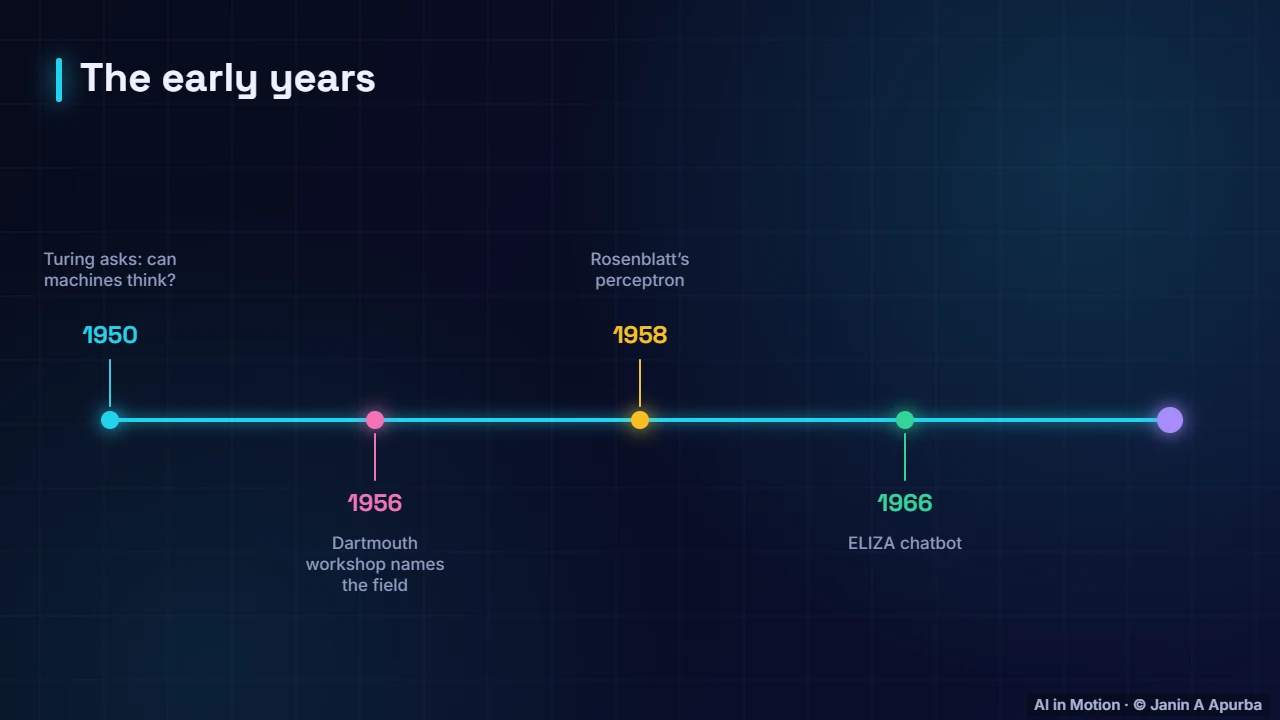
The early years. In 1950 Alan Turing asked whether machines can think. In 1956 the Dartmouth workshop gave the field its name. Rosenblatt built the perceptron in 1958, and ELIZA chatted with people in 1966. But promises outran results, and funding dried up in the first AI winter.
Expert systems to Deep Blue. The 1980s brought expert systems, rule-based programs used by businesses. Backpropagation was popularised in 1986, but another winter followed. In 1997 IBM’s Deep Blue beat world chess champion Garry Kasparov.
Deep learning era. In 2012 a deep neural network called AlexNet crushed an image recognition contest, starting the deep learning era. AlphaGo beat a Go champion in 2016. The Transformer arrived in 2017, powering the large language models behind ChatGPT, released in 2022.
Why now?. Why did progress speed up? Four ingredients arrived together. Massive data from the internet. Fast graphics processors. Better training ideas. And an open research culture that shared code and results.
Recap. The story in four beats. The question and the name in the fifties. Expert systems in the eighties. Deep learning from 2012. And transformers and generative AI since 2017.