What Is Artificial Intelligence?
A clear, visual introduction: what AI is, how modern AI learns from data, and how AI, machine learning and deep learning fit together.
📄 Illustrated notes · every chapter as a picture · printable
Quick quiz
3 questions to check your understanding.
Go deeper
University-level written lectures in The AI Lecture Hall:
Transcript
Introduction. Welcome to AI in Motion. In this first lesson we answer a simple question: what exactly is artificial intelligence? No jargon, just pictures.
Definition. Artificial intelligence is the science of building computer systems that do things we normally link with human intelligence. Seeing, understanding language, reasoning, planning and learning.
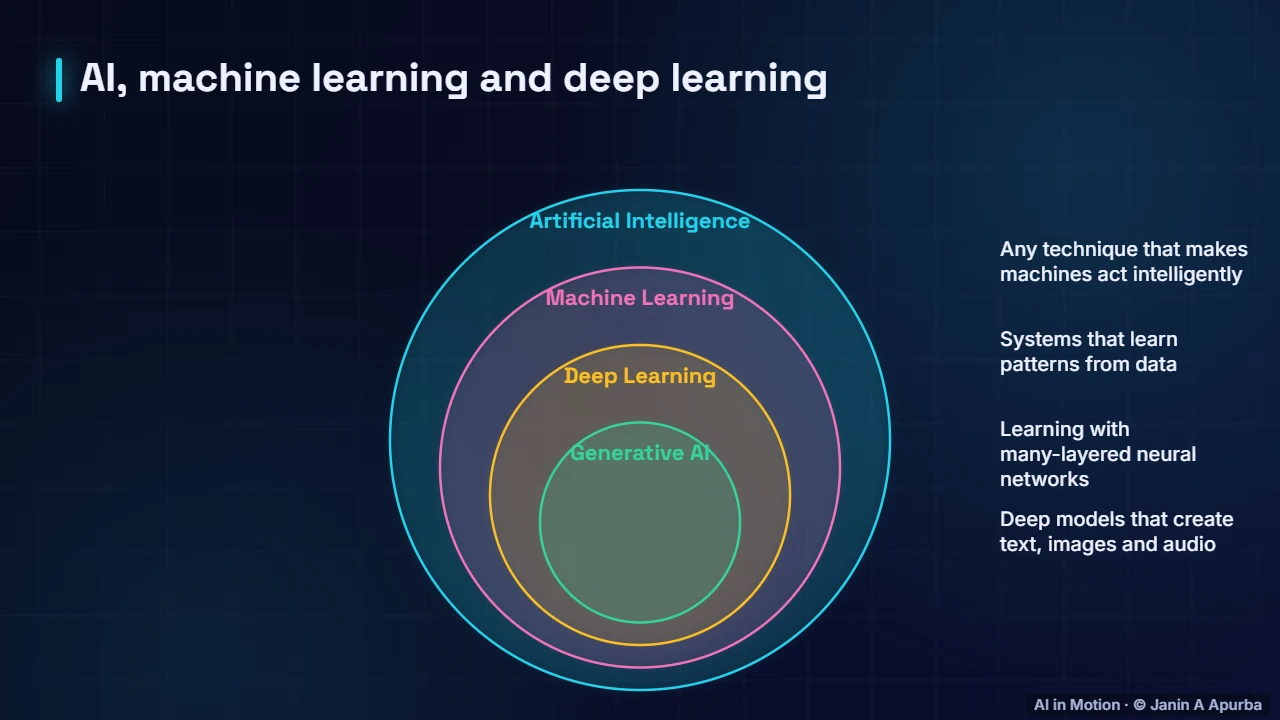
The family tree. These terms are nested circles. Artificial intelligence is the whole field. Machine learning is the part that learns from data. Deep learning uses many-layered neural networks. And generative AI, like chatbots and image generators, sits inside deep learning.
Rules vs learning. Early AI relied on rules written by human experts. That works for tidy problems, but real life is messy. Modern AI mostly learns from examples instead, finding the patterns itself.
The learning loop. Most modern AI follows a loop. Collect data. Train a model on it. Use the model to make predictions on new inputs. Then use feedback and fresh data to improve it again.
Narrow vs general. All the AI we use today is narrow AI. It can be superhuman at one kind of task, but it cannot do everything a person can. General AI, matching humans at any task, does not exist yet.
Recap. To recap. AI is the broad goal. Machine learning learns from data. Deep learning uses deep neural networks. And every AI system today is narrow, brilliant at specific tasks.