Intelligent Agents: Perceive, Decide, Act
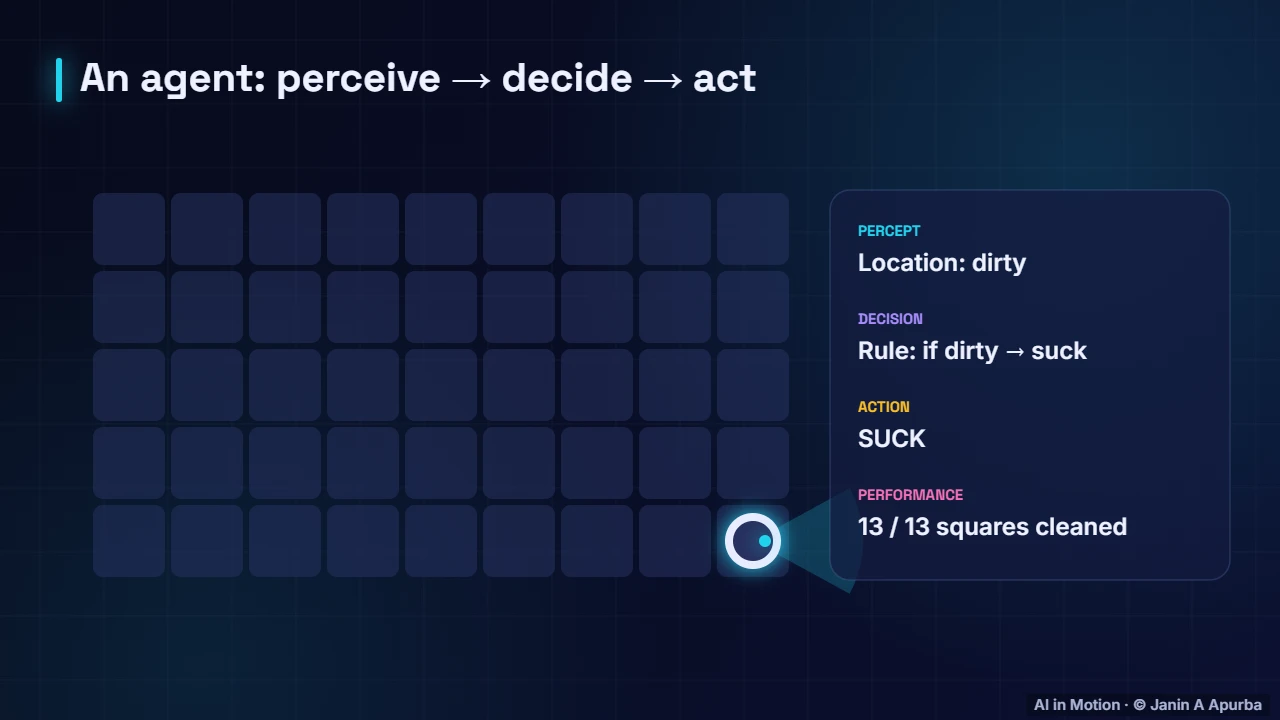
Watch a robot vacuum perceive its world, decide and act — the agent loop that underlies everything from thermostats to AI assistants.
📄 Illustrated notes · every chapter as a picture · printable
Quick quiz
3 questions to check your understanding.
Go deeper
University-level written lectures in The AI Lecture Hall:
Transcript
Introduction. In AI, an agent is anything that perceives its environment and acts on it to achieve a goal. Let us watch one at work.
A cleaning agent. Here is a simple robot vacuum. Its sensor perceives whether the current square is dirty. A rule decides what to do. If dirty, suck. If clean, move on. Its performance is measured by how many squares it cleans.
The agent loop. Every agent runs the same loop. Perceive through sensors. Decide what to do. Act through actuators. And the best agents also learn from the results, getting better over time.
Types of agents. Agents come in levels of sophistication. Simple reflex agents follow if-then rules. Model-based agents remember the world. Goal-based agents plan. Utility-based agents weigh trade-offs. And learning agents improve with experience.
PEAS. To design an agent, describe it with PEAS. Performance measure, environment, actuators and sensors. For our vacuum, that is squares cleaned, the rooms, wheels and suction, and a dirt sensor.
Recap. Remember: an agent perceives and acts. Sensors bring information in, actuators change the world. Agents range from simple rules to learning systems, and PEAS describes any of them.