Artificial Neurons and the Perceptron
Inside a single artificial neuron: weighted inputs, a sum, a bias and an activation — plus the perceptron that learns from its mistakes.
📄 Illustrated notes · every chapter as a picture · printable
Quick quiz
3 questions to check your understanding.
Go deeper
University-level written lectures in The AI Lecture Hall:
Transcript
Introduction. Every neural network, from a tiny classifier to a giant language model, is built from one simple unit: the artificial neuron. Let us open one up.
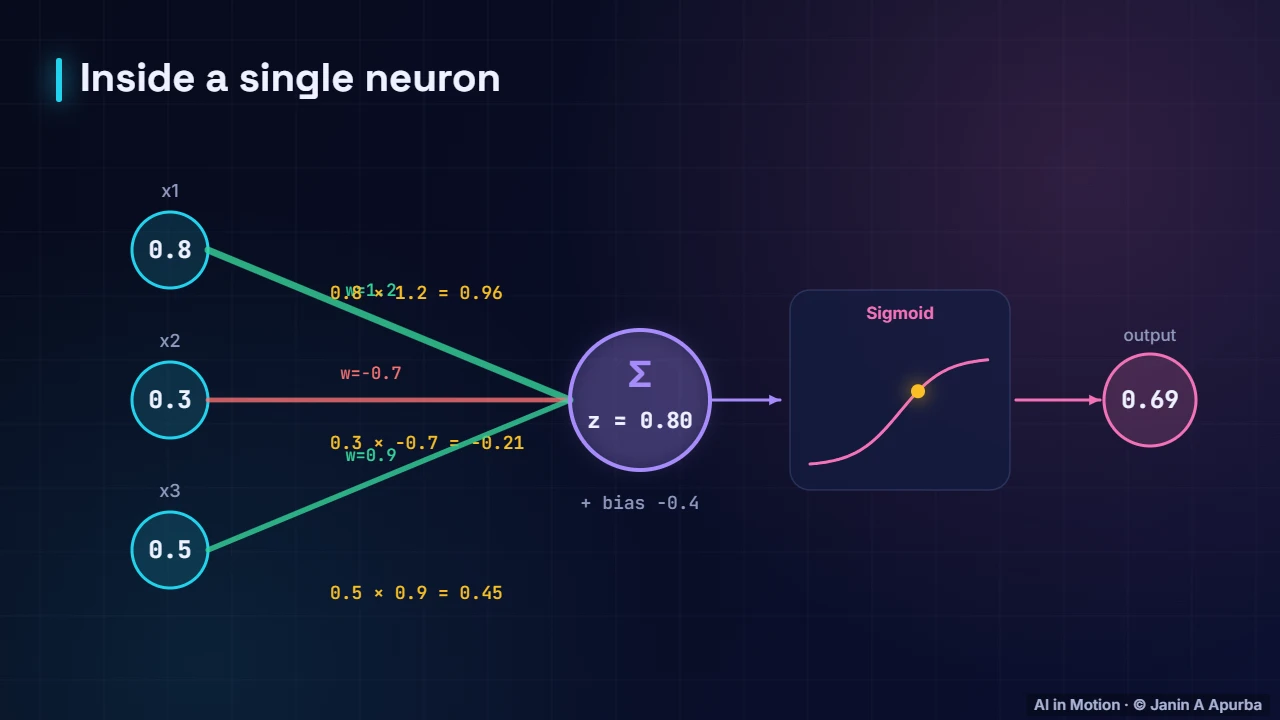
Inside a neuron. A neuron receives inputs. Each input is multiplied by a weight. Here, 0.8 times 1.2, 0.3 times minus 0.7, and 0.5 times 0.9. The neuron adds them up with a bias of minus 0.4, giving z equals 0.8. Then an activation function, here the sigmoid, turns that into an output of 0.69.
The formula. In one line: the output is an activation function applied to the weighted sum of the inputs plus a bias. Learning simply means finding good weights and biases.
Inspired by biology. Artificial neurons were inspired by brain cells, which receive signals and fire when stimulated enough. But the inspiration is loose. An artificial neuron is simple maths, not a model of real biology.
The perceptron learns. In 1958 Frank Rosenblatt built the perceptron, a single neuron that learns. When it misclassifies a point, it nudges its weights towards the right answer. Here the boundary moves until most points are on the correct side.
Recap. To recap. A neuron multiplies inputs by weights, adds a bias, and applies an activation. Learning means adjusting those weights. And the perceptron was the first neuron that learned.