Artificial Neurons and the Perceptron — lecture notes
Inside a single artificial neuron: weighted inputs, a sum, a bias and an activation — plus the perceptron that learns from its mistakes.
0:001. Introduction
Every neural network, from a tiny classifier to a giant language model, is built from one simple unit: the artificial neuron. Let us open one up.
0:112. Inside a neuron
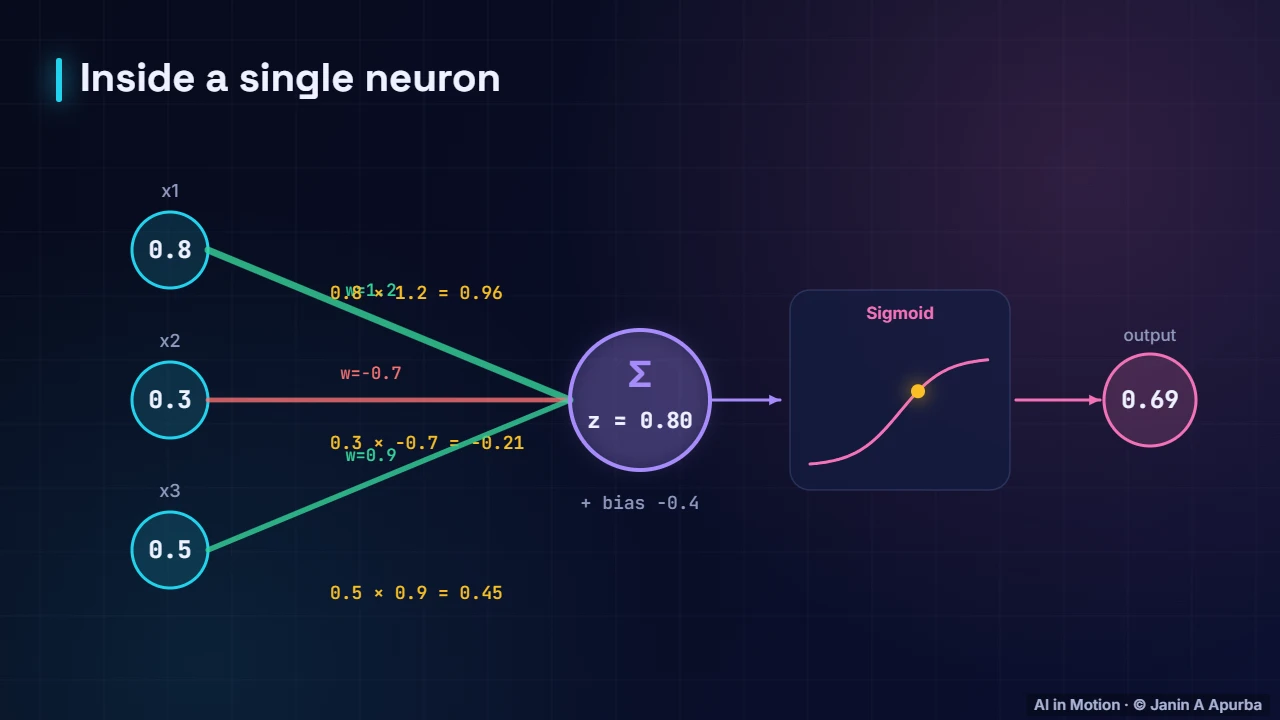
A neuron receives inputs. Each input is multiplied by a weight. Here, 0.8 times 1.2, 0.3 times minus 0.7, and 0.5 times 0.9. The neuron adds them up with a bias of minus 0.4, giving z equals 0.8. Then an activation function, here the sigmoid, turns that into an output of 0.69.
0:333. The formula
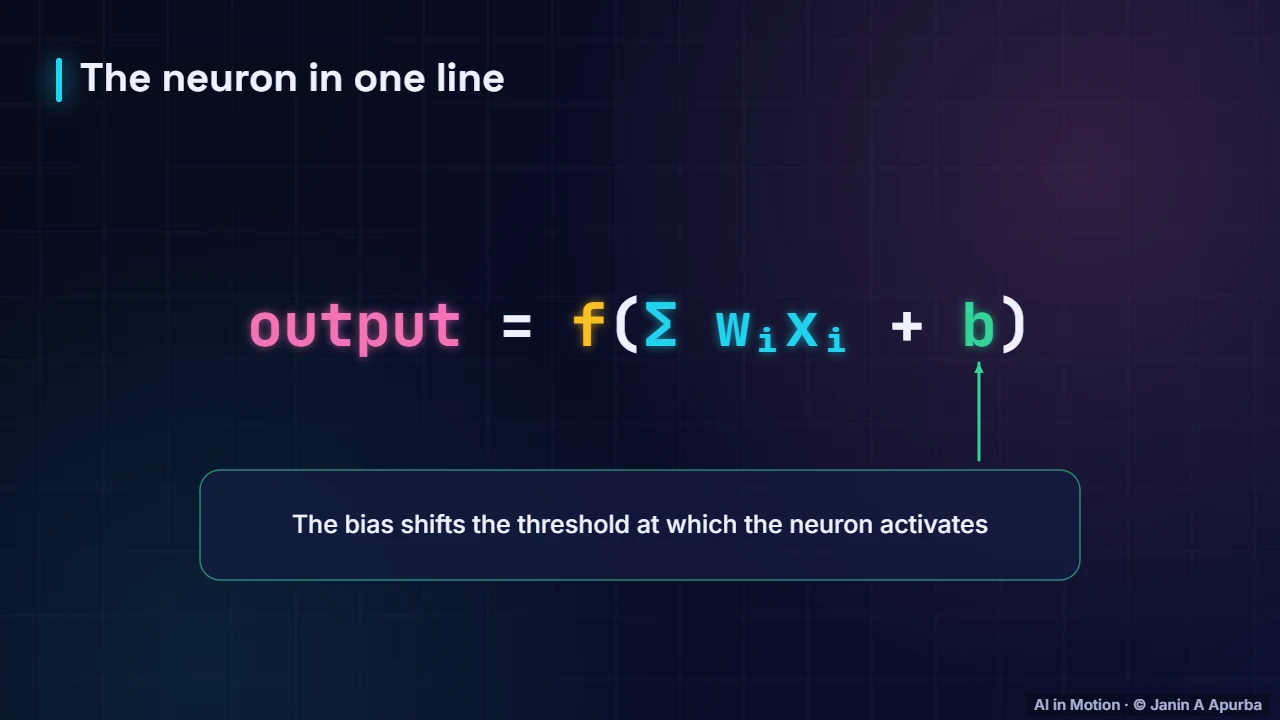
In one line: the output is an activation function applied to the weighted sum of the inputs plus a bias. Learning simply means finding good weights and biases.
0:464. Inspired by biology
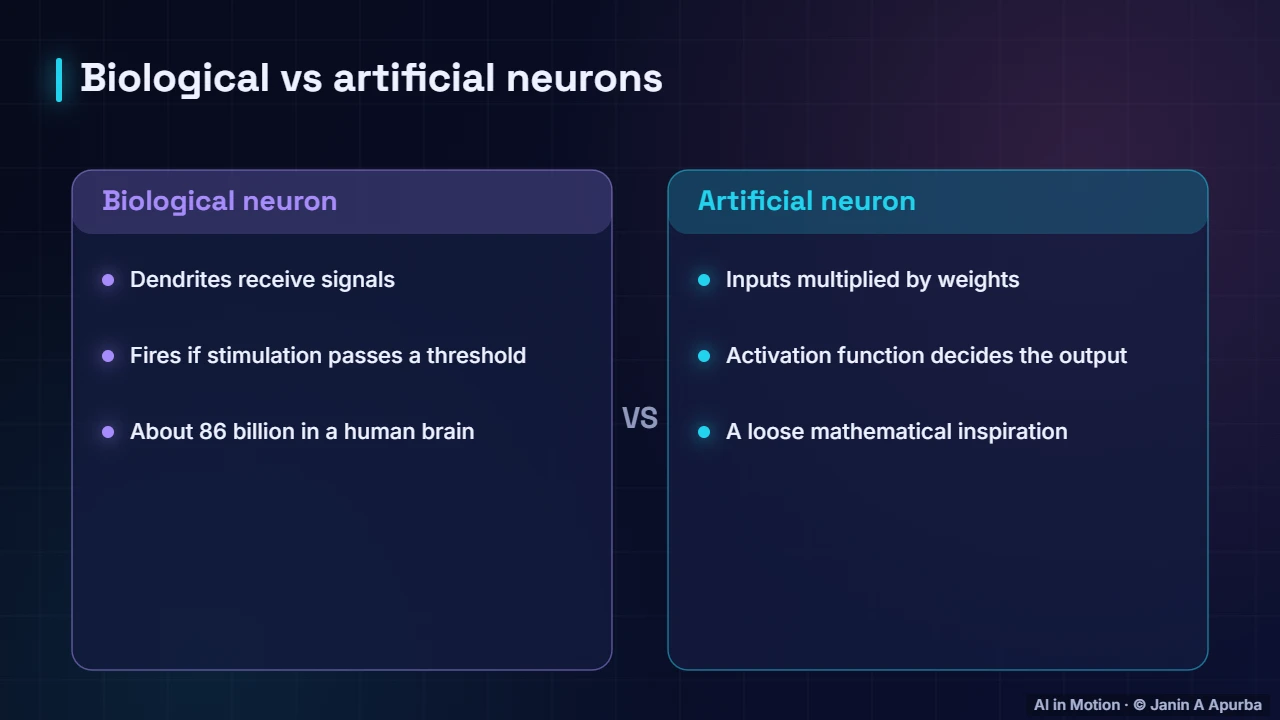
Artificial neurons were inspired by brain cells, which receive signals and fire when stimulated enough. But the inspiration is loose. An artificial neuron is simple maths, not a model of real biology.
1:005. The perceptron learns
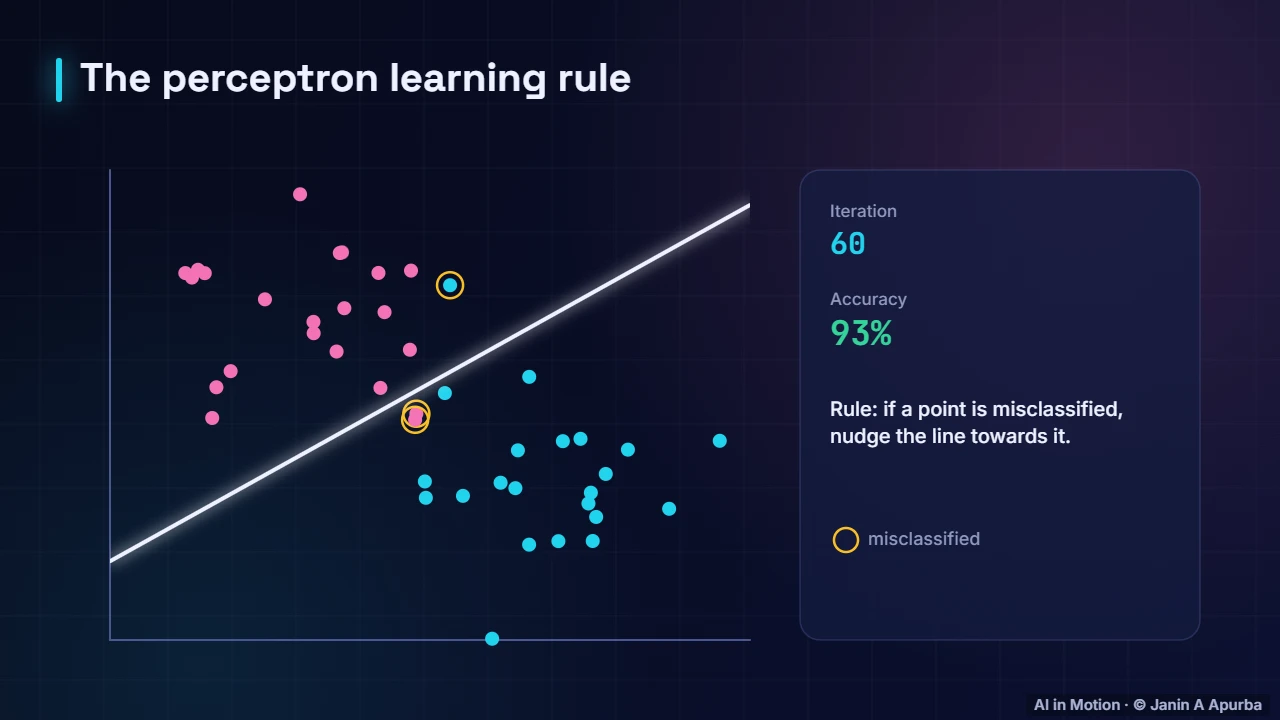
In 1958 Frank Rosenblatt built the perceptron, a single neuron that learns. When it misclassifies a point, it nudges its weights towards the right answer. Here the boundary moves until most points are on the correct side.
1:166. Recap
To recap. A neuron multiplies inputs by weights, adds a bias, and applies an activation. Learning means adjusting those weights. And the perceptron was the first neuron that learned.
Key takeaways
- A neuron computes f(Σ wᵢxᵢ + b).
- In the example: z = 0.80 and sigmoid(0.80) ≈ 0.69.
- Weights and biases are what a network learns.
- The perceptron (Rosenblatt, 1958) updates its weights when it makes a mistake.
Check yourself
- What does a weight do?
Show answer
Scales how much an input influences the neuron — Each input is multiplied by its weight.
- What is the role of the activation function?
Show answer
It turns the weighted sum into the neuron’s output, adding non-linearity — Activations such as sigmoid or ReLU shape the output.
- When does the perceptron update its weights?
Show answer
When it misclassifies an example — It learns only from mistakes.
Go deeper
- From Biological Neurons to Artificial Neural Networks · The AI Lecture Hall
- The Perceptron: The First Learning Machine · The AI Lecture Hall
© 2026 Janin A Apurba, CSE, AUST · Advanced ICT Officer, CNRS-UNHCR. All rights reserved. Notes for the animated lecture at https://ai-in-motion.vercel.app/watch/artificial-neurons-and-the-perceptron.html