How Computers See Images — lecture notes
To a computer, a picture is a grid of numbers. Zoom into the pixels, read their values and split a colour image into red, green and blue channels.
0:001. Introduction
You see a house, the sun and green hills. A computer sees none of that. It sees a grid of numbers. Computer vision is the science of turning those numbers into understanding.
0:142. Pixels are numbers
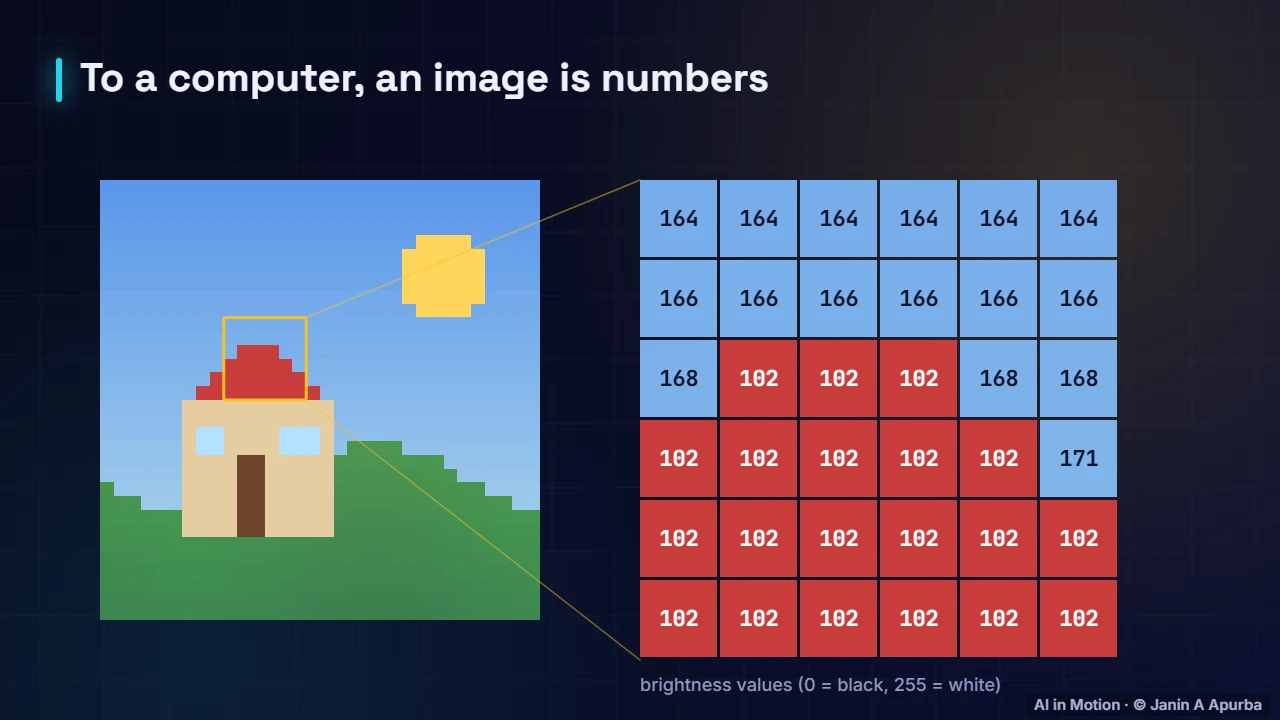
This small image is 32 by 32 pixels. The yellow box zooms into a six by six patch. Each square is one pixel, and the number is its brightness, from zero for black to 255 for white. The whole image is just a table of numbers like these.
0:343. Colour channels
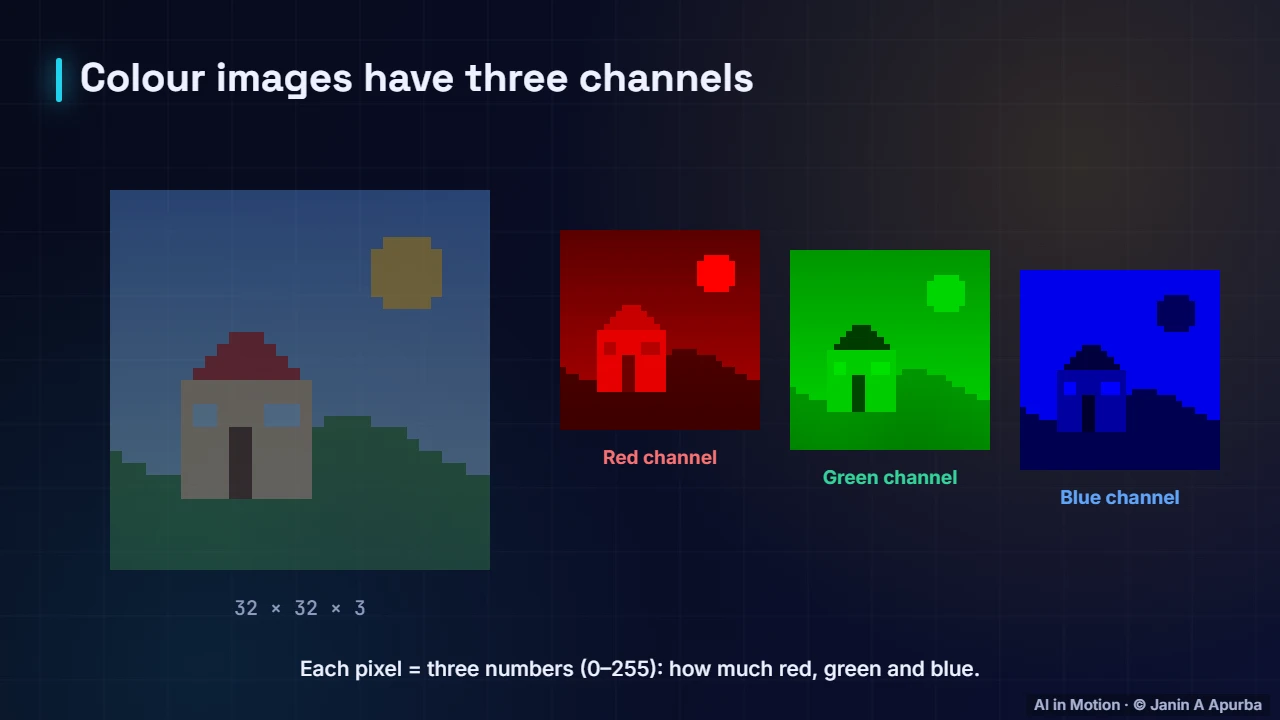
Colour images store three numbers per pixel: how much red, green and blue light to mix. So a colour image is really three grids stacked together, called channels. A 32 by 32 colour image holds 32 times 32 times 3, which is 3072 numbers.
0:534. Why it is hard
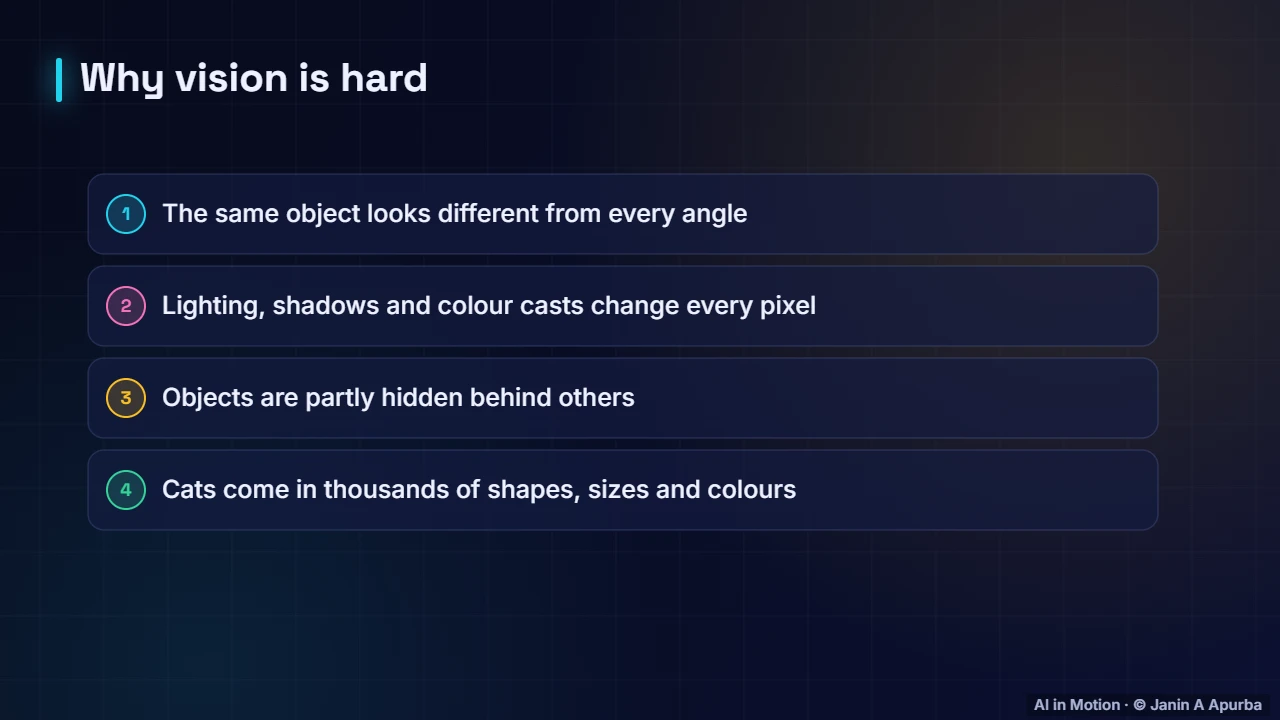
Why is this hard? The same cat photographed from a different angle, in different light, or half hidden behind a sofa, produces completely different numbers. A vision system must see past all that variation.
1:085. Main tasks
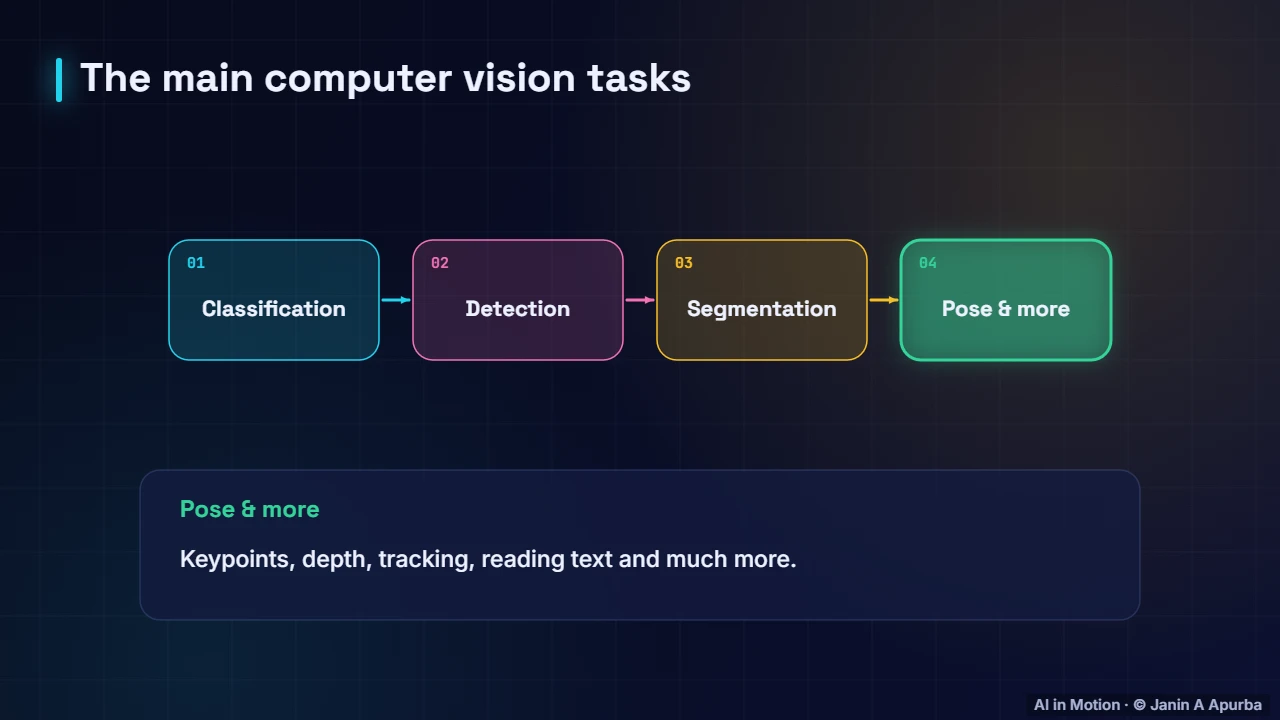
The main tasks build on each other. Classification labels the whole image. Detection finds and boxes each object. Segmentation labels every pixel. And there is much more: pose, depth, tracking and reading text.
1:226. Recap
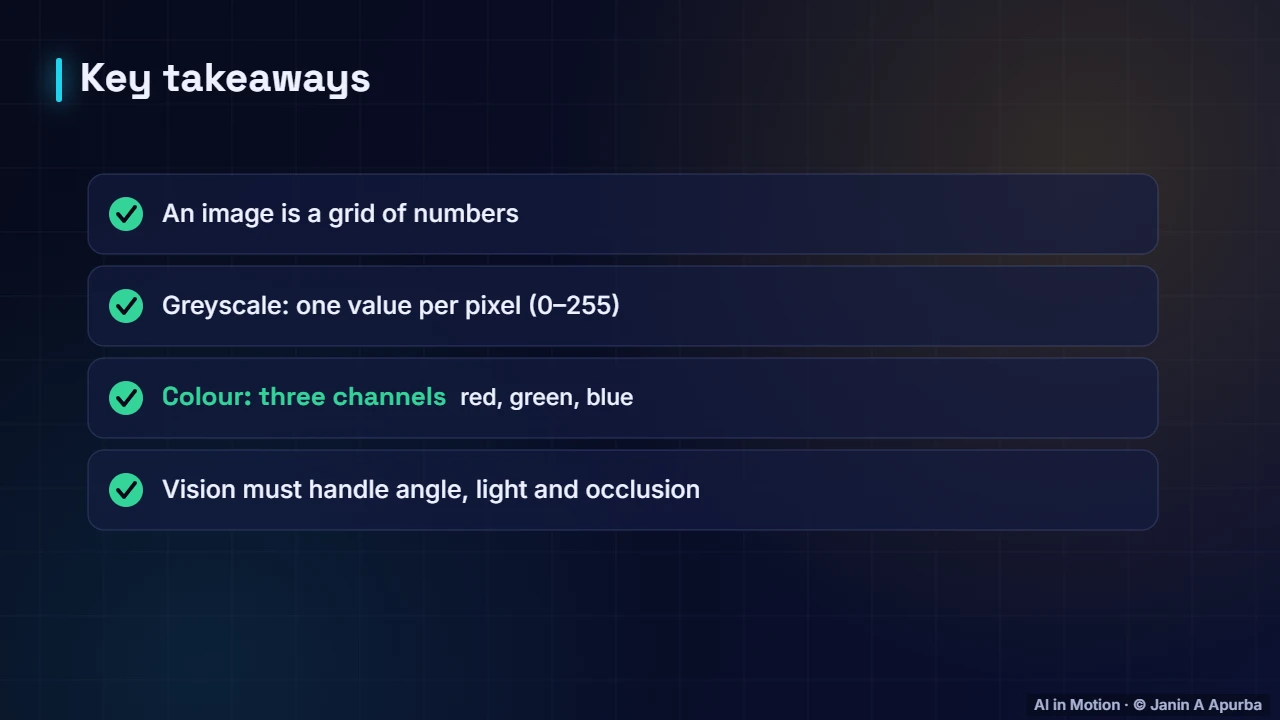
To recap. Images are grids of numbers. Greyscale uses one value per pixel, colour uses three channels. And vision systems must cope with endless variation in angle, light and occlusion.
Key takeaways
- A digital image is a grid of numbers; each pixel’s brightness is 0–255.
- Colour images have three channels: red, green and blue.
- A 32 × 32 colour image contains 3,072 numbers.
- Viewpoint, lighting and occlusion make recognition difficult.
Check yourself
- In an 8-bit greyscale image, what does 255 represent?
Show answer
White — 0 is black and 255 is white.
- How many numbers describe one pixel in a colour (RGB) image?
Show answer
3 — One value each for red, green and blue.
- Which task labels every pixel?
Show answer
Segmentation — Segmentation assigns a class to each pixel.
Go deeper
- Introduction to Computer Vision: From Pixels to Perception · The AI Lecture Hall
- Image Processing Fundamentals: Filtering, Convolution and Edge Detection · The AI Lecture Hall
© 2026 Janin A Apurba, CSE, AUST · Advanced ICT Officer, CNRS-UNHCR. All rights reserved. Notes for the animated lecture at https://ai-in-motion.vercel.app/watch/how-computers-see-images.html