What Is Natural Language Processing?
How computers read, understand and generate human language — the tasks, the pipeline and how the field moved from rules to neural networks.
📄 Illustrated notes · every chapter as a picture · printable
Quick quiz
3 questions to check your understanding.
Go deeper
University-level written lectures in The AI Lecture Hall:
Transcript
Introduction. Every search you type, every translation and every chatbot reply relies on natural language processing: the science of getting computers to work with human language.
NLP tasks. NLP covers many tasks. Classifying text, extracting names and facts, translating between languages, answering questions, and generating new text, from summaries to conversations.
The pipeline. Almost every NLP system follows the same path. Raw text is split into tokens. Tokens become vectors of numbers. A model processes those vectors, and produces an output: a label, a translation, an answer or new text.
Why it is hard. Language is hard for computers. Words are ambiguous: is a bank beside a river or full of money? And people use slang, typos, emojis, sarcasm and thousands of languages. Context is everything.
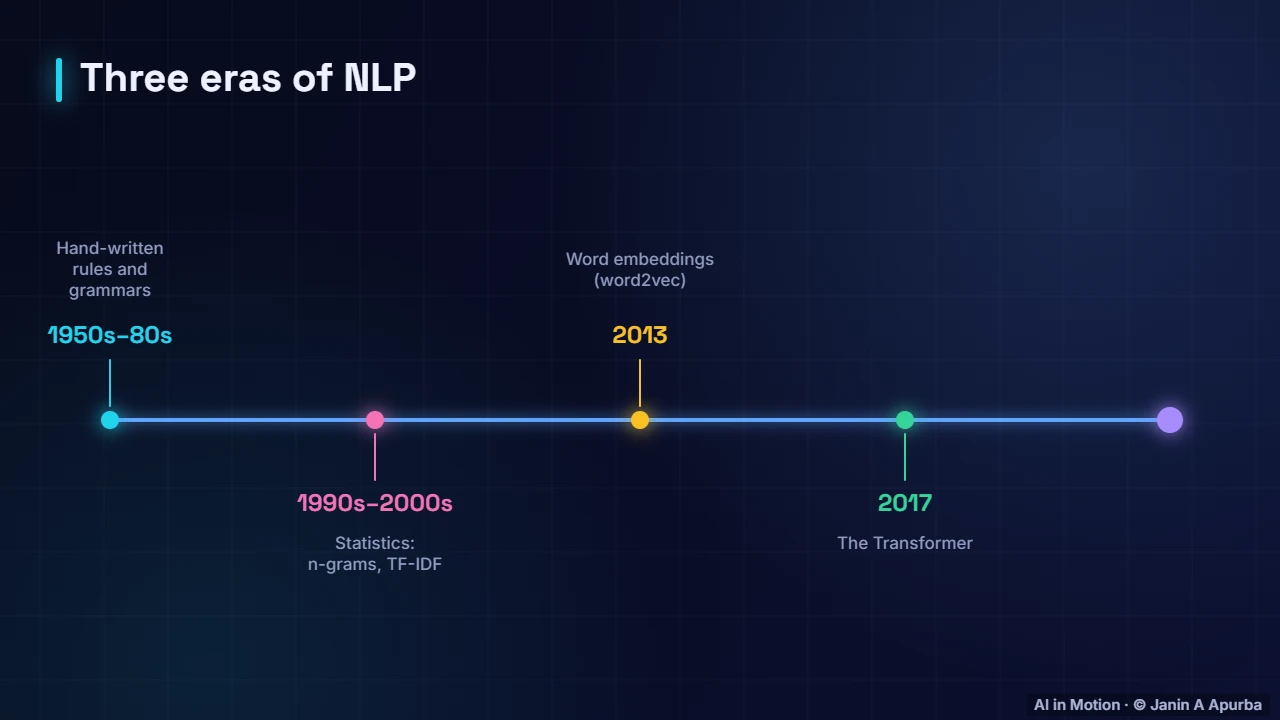
Three eras. NLP moved through three eras. First hand-written rules. Then statistics, counting words and word pairs. Then neural networks: word embeddings in 2013, the Transformer in 2017, and huge pre-trained models like BERT and GPT.
Recap. To recap. NLP classifies, extracts, translates and generates. Text becomes tokens and vectors before any model sees it. Ambiguity makes it hard. And the field moved from rules to statistics to neural networks.