Human Pose Estimation — lecture notes
Find a person’s joints — shoulders, elbows, knees — and connect them into a skeleton that can be tracked over time.
0:001. Introduction
Fitness apps count your squats, games follow your dance moves, and sports analysts study athletes’ movements. All of them use pose estimation.
0:102. Heatmaps to skeleton
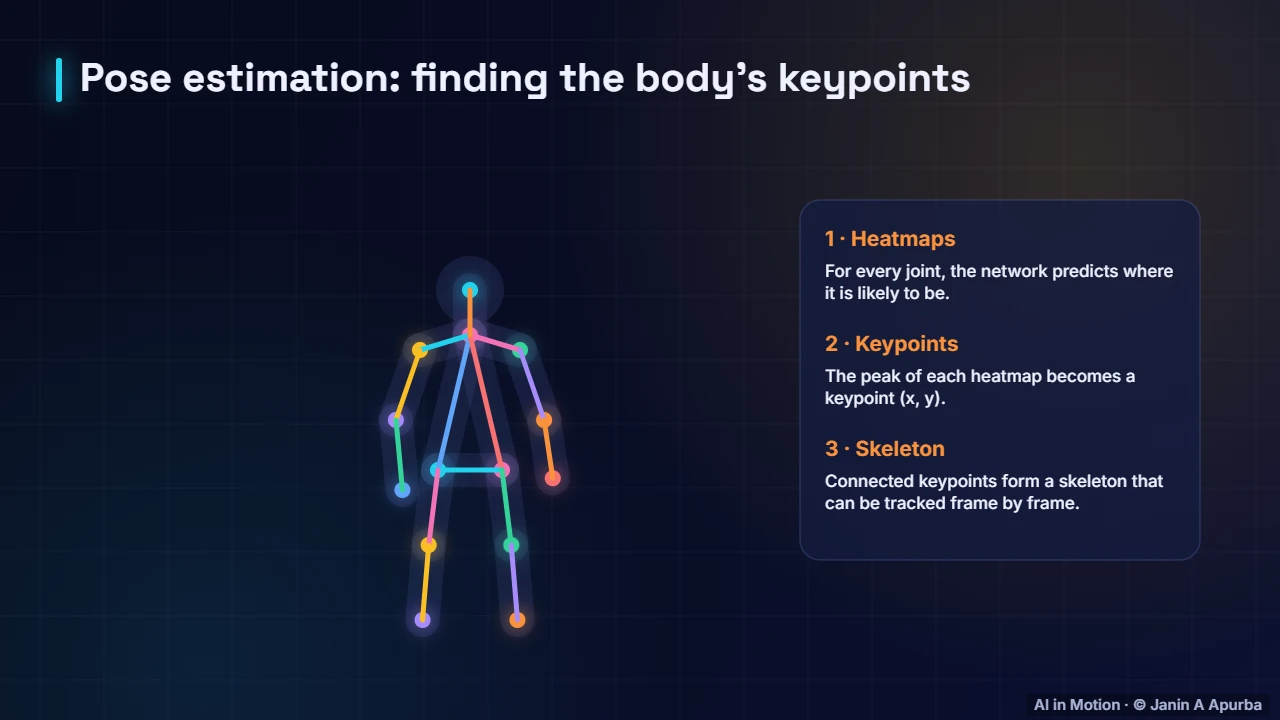
The network first predicts a heatmap for every joint: a glowing blob showing where the left elbow, right knee and so on are likely to be. The peak of each heatmap becomes a keypoint. Connecting the keypoints gives a skeleton, which can be tracked frame by frame as the person moves.
0:313. Many people
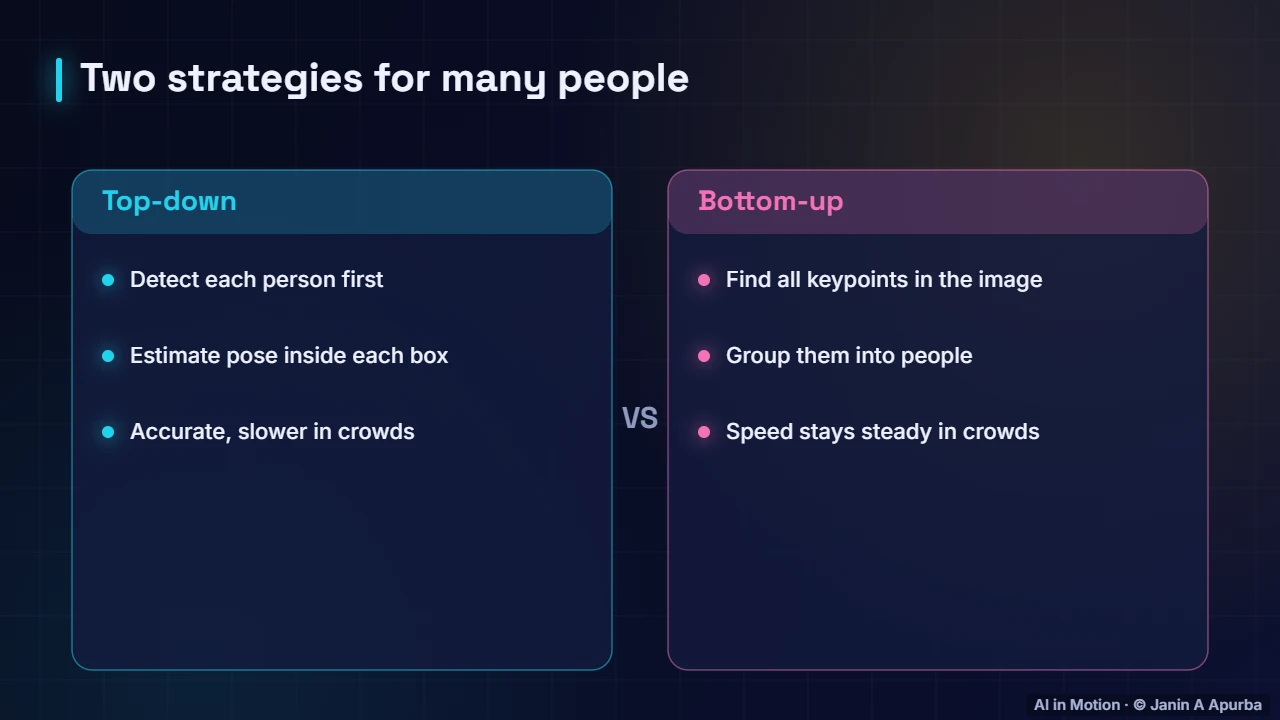
With several people, top-down methods first detect each person, then estimate their pose: accurate, but slower as crowds grow. Bottom-up methods find all the joints first and then group them into people.
0:454. Applications
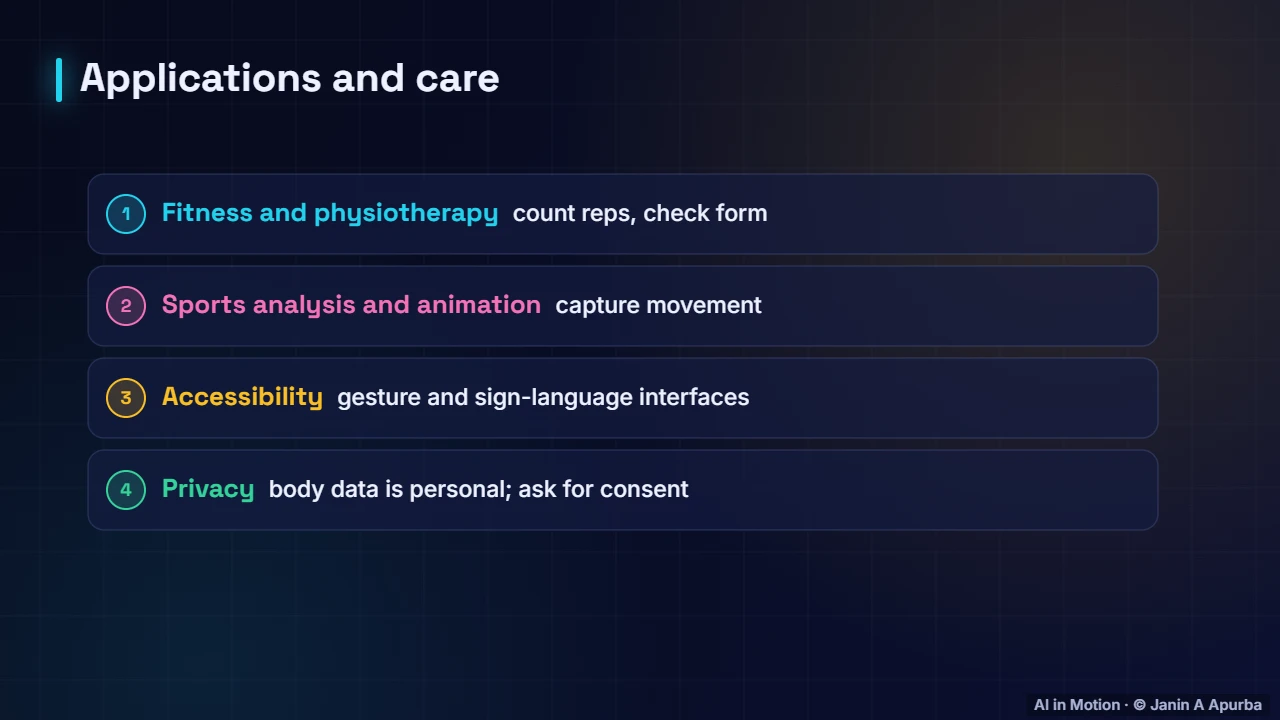
Pose estimation helps fitness and physiotherapy apps, sports analysis, animation and gesture interfaces. But body movement is personal data, so use it with consent and care.
0:575. Recap
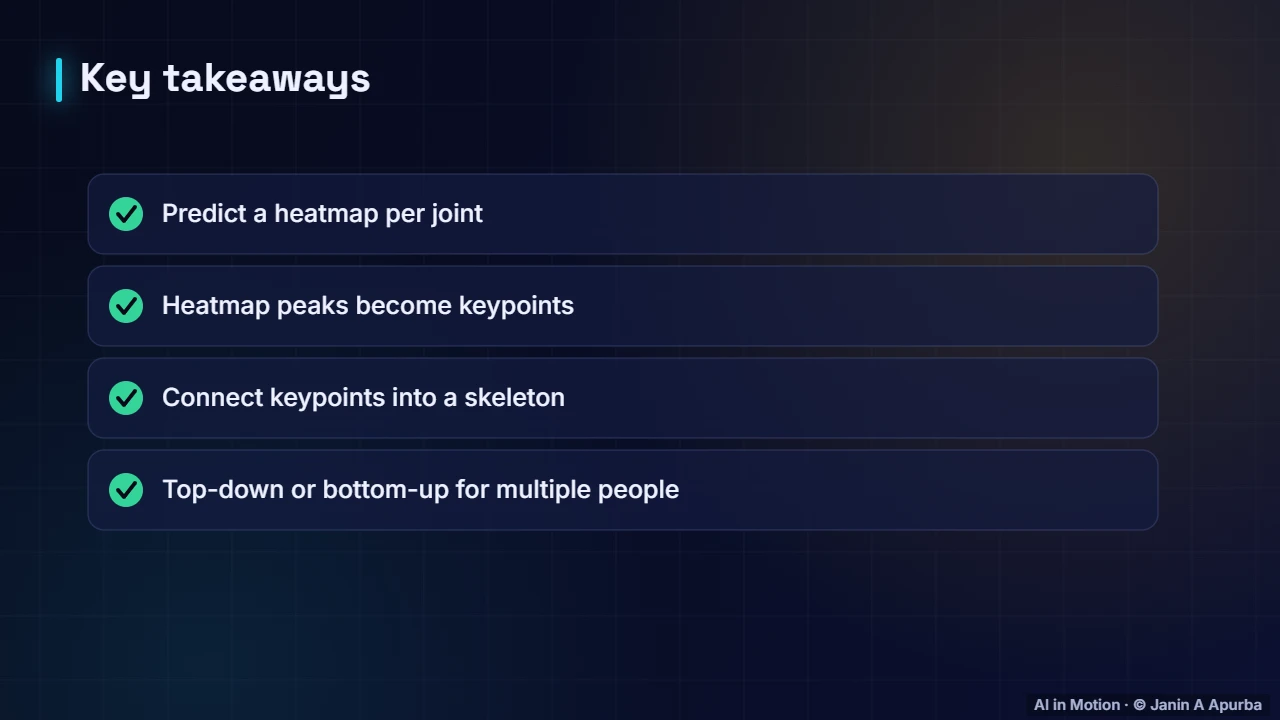
To recap. Predict heatmaps, pick their peaks as keypoints, connect them into a skeleton, and choose top-down or bottom-up for multiple people.
Key takeaways
- Pose estimation locates body keypoints such as shoulders, elbows and knees.
- Networks often predict a heatmap per joint; its peak gives the keypoint.
- Keypoints are connected into a skeleton and tracked over time.
- Top-down detects people first; bottom-up finds joints first and groups them.
Check yourself
- What does a keypoint heatmap show?
Show answer
Where a particular joint is likely to be — Each heatmap scores possible locations for one joint.
- Top-down pose estimation first…
Show answer
Detects each person — It estimates poses inside detected person boxes.
- Why should pose data be handled carefully?
Show answer
Body movement is personal data — Privacy and consent matter.
Go deeper
- Human Pose Estimation · The AI Lecture Hall
- Video Understanding: Action Recognition and Temporal Modelling · The AI Lecture Hall
© 2026 Janin A Apurba, CSE, AUST · Advanced ICT Officer, CNRS-UNHCR. All rights reserved. Notes for the animated lecture at https://ai-in-motion.vercel.app/watch/pose-estimation.html