Image Classification End to End — lecture notes
From a labelled dataset to a trained classifier: the full pipeline, softmax probabilities and how to judge the results.
0:001. Introduction
Image classification answers one question: what is in this picture? Let us walk through the whole pipeline, from data to prediction.
0:092. Picture to prediction
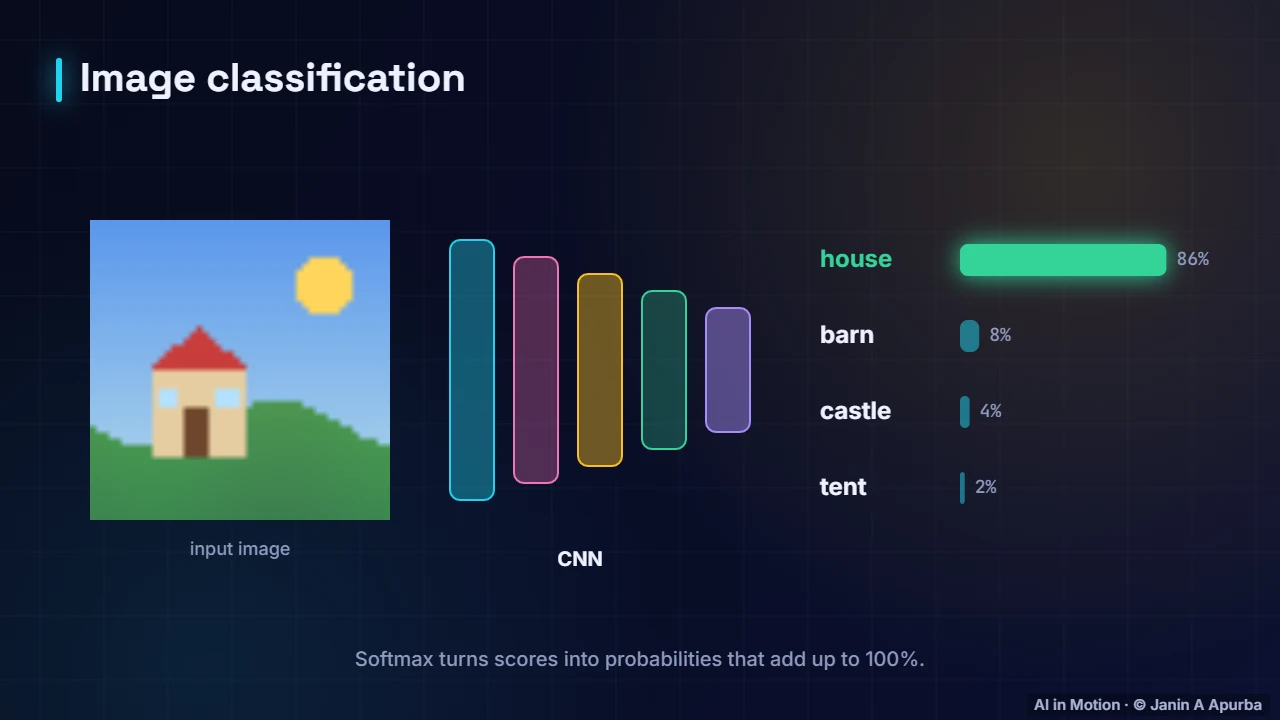
An image goes in. A convolutional network extracts features layer by layer. The final layer gives a score for each class, and softmax turns those scores into probabilities: here 86 percent house, 8 percent barn, 4 percent castle and 2 percent tent.
0:273. The pipeline
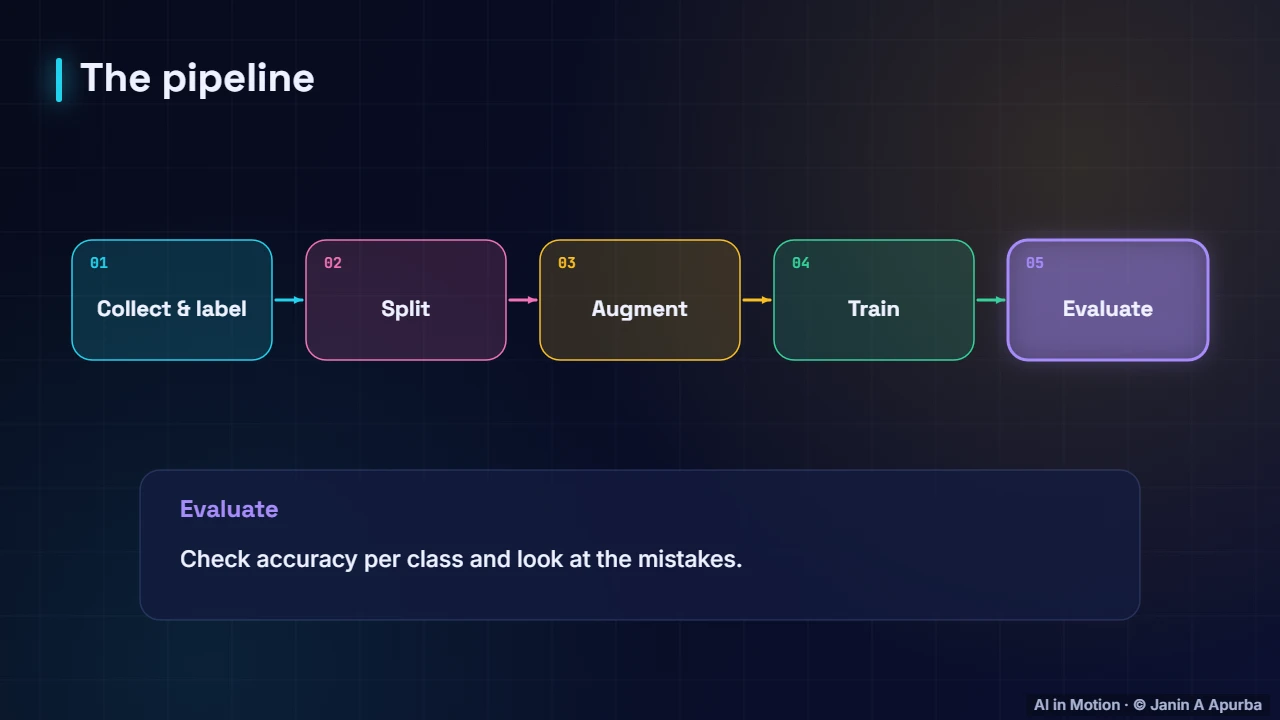
Collect and label images for every class. Split off validation and test sets. Augment the training images for variety. Train, usually by fine-tuning a pretrained network. Then evaluate, class by class, and study the mistakes.
0:434. Softmax
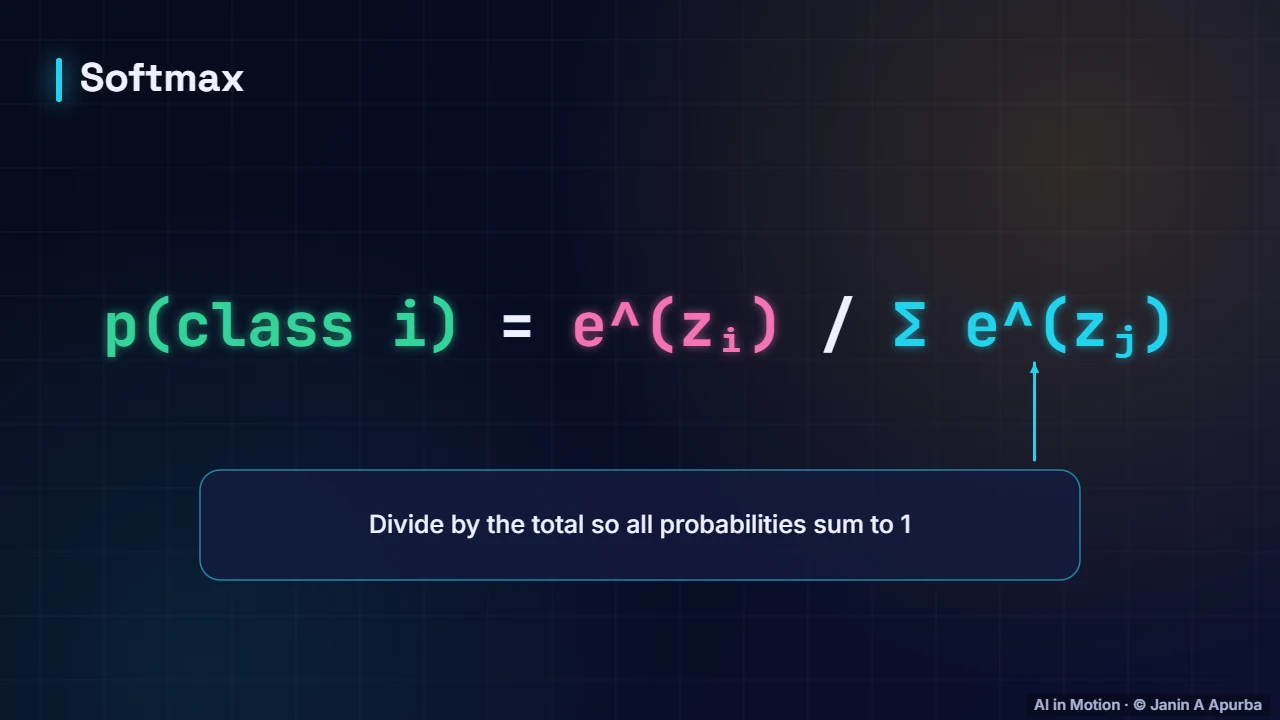
Softmax exponentiates each class score so it is positive, then divides by the total so everything sums to one. The largest score gets the largest probability.
0:555. Pitfalls
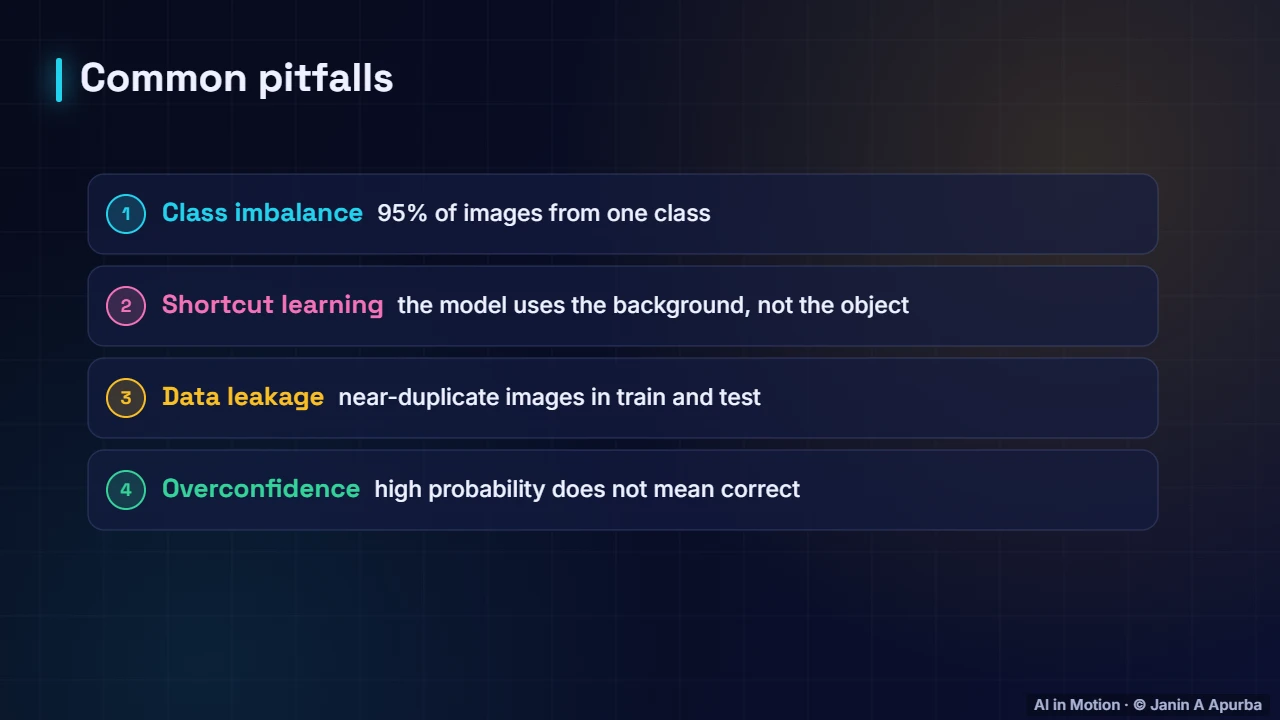
Watch for pitfalls. Imbalanced classes. Shortcut learning, where the model looks at the background instead of the object. Near duplicate images leaking into the test set. And overconfidence: a high probability is not a guarantee.
1:106. Recap
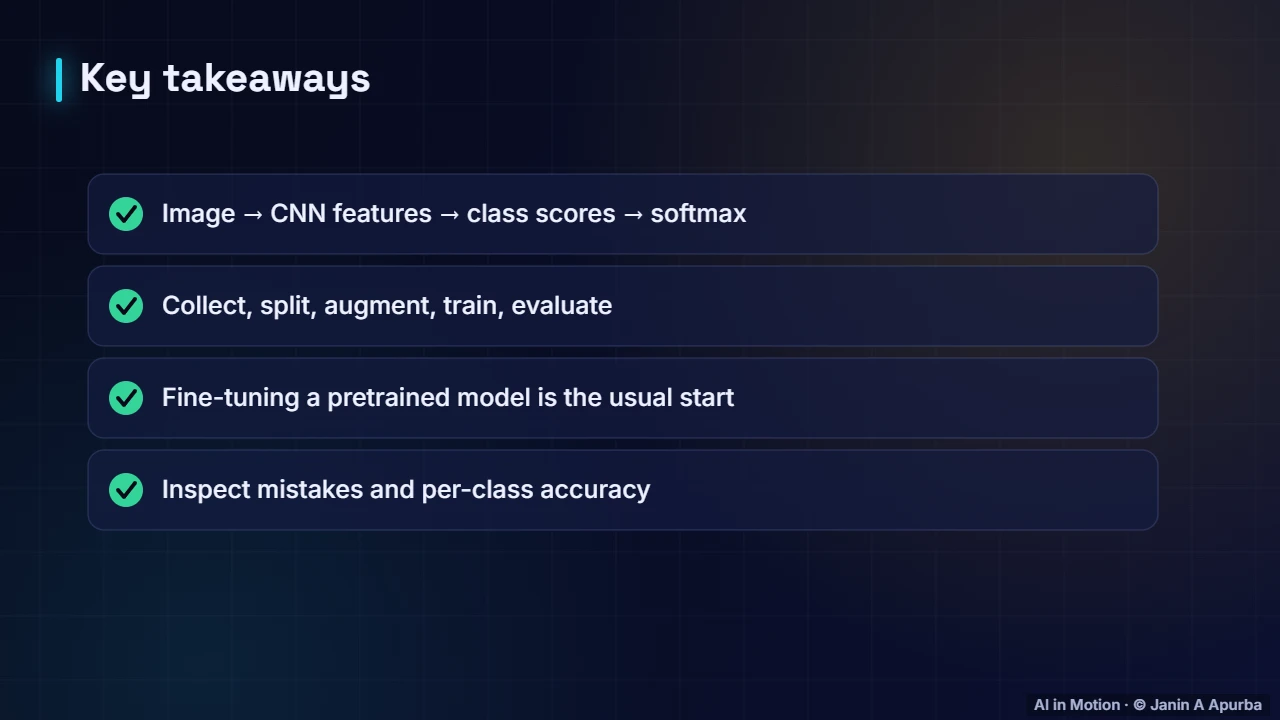
To recap. Image, features, scores, softmax. Collect, split, augment, train and evaluate. Start from a pretrained model, and always inspect the mistakes.
Key takeaways
- A classifier maps an image to class probabilities via softmax.
- The pipeline: collect/label, split, augment, train, evaluate.
- Fine-tuning a pretrained network is the usual starting point.
- Beware imbalance, shortcut learning, leakage and overconfidence.
Check yourself
- What do softmax outputs add up to?
Show answer
1 (100%) — Softmax normalises the scores into a probability distribution.
- A model recognises cows only when there is grass in the picture. This is…
Show answer
Shortcut learning — It relies on a spurious background cue.
- What is usually the best way to start a new image classifier?
Show answer
Fine-tune a pretrained network — Transfer learning works well with limited data.
Go deeper
- Building an Image Classification Pipeline End to End · The AI Lecture Hall
- Transfer Learning and Fine-Tuning · The AI Lecture Hall
- Softmax Regression and Multiclass Classification Strategies · The AI Lecture Hall
© 2026 Janin A Apurba, CSE, AUST · Advanced ICT Officer, CNRS-UNHCR. All rights reserved. Notes for the animated lecture at https://ai-in-motion.vercel.app/watch/image-classification.html